Auditing a contract
activeledger audit reads contract source and prints what is wrong with it before you deploy. It changes nothing and needs no running node.
activeledger audit <file|folder> [--json] [--offline] [--fail-on <severity>]
                                 [--only <rules>] [--skip <rules>] [--rules]
Contracts are TypeScript (a node transpiles the source it is sent), so it reads every .ts file under the path. A JavaScript file is skipped, and the run says how many were. It skips node_modules, hidden folders, build output (lib, dist, es, build) and .d.ts files.
What you get
One table per file, then the duplicate blocks, then a summary:
contracts/transfer.ts
  Line  Severity  Rule             Finding                                   Fix
  14    critical  no-eval          eval() runs text as code                  Remove it. Parse the data instead of running it.
  31    high      local-service    "http://127.0.0.1:8080" is this machine   Remove it.
  58    medium    swallowed-error  an empty catch hides the failure          Reject with the error, or handle it.
  Risk 39/100 (medium)   critical 1  high 1  medium 1  low 0

Summary
  Files 1   Findings 3   Critical 1  High 1  Medium 1  Low 0
  Overall risk 39/100 (medium)   worst file 39, average 39
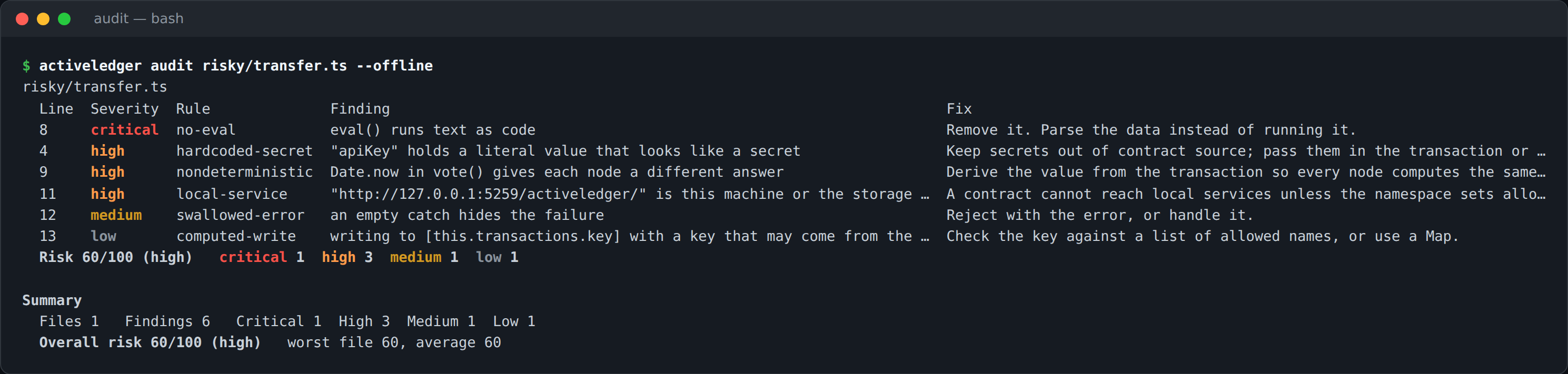
A contract written to be wrong: it runs eval, holds a key, reads the clock in vote, reaches for the storage port and hides an error.
--json prints the same data for tooling. --rules lists every rule and exits.
What it checks
| Group | Rules |
|---|---|
| Security | no-eval, forbidden-global (process, global, timers, console and the rest the deploy scan refuses), module-use (require or import of anything but the toolkits, local files, dynamic names), prototype-access, computed-write, local-service (storage and loopback addresses, volatile paths and request options that change the connection, the patterns the storage-guard red-team passes found), hardcoded-secret, weak-crypto |
| Contract | nondeterministic (time and randomness inside verify, vote and commit, where each node would answer differently), contract-shape (no class extending Standard, Event or PostProcess; a { leader: true } vote), unbounded-loop |
| Best practice | swallowed-error, long-function (over 80 lines, or nested over 5 deep) |
| Duplicate code | duplicate-code: blocks of 6 or more meaningful lines that appear twice, in two files or one |
| Hygiene | todo, large-file |
| Dependencies | every package a contract imports is looked up in the npm advisory database; each advisory is a finding. unpinned-version for a range such as ^1.2.0, unknown-version when no version can be found |
The audit is advice. The node's own deploy scan is the check that decides; a clean audit does not promise a deploy will pass, and a finding does not always mean it will fail.
Dependencies
The version is the installed one (node_modules/<package>/package.json, looking up the folders), otherwise the one declared in the nearest package.json. Only package names and versions are sent to the npm registry, never source. --offline skips the lookup; the run says so in a note. If the registry cannot be reached the run carries on and says that too.
The risk score
Each finding adds points: critical 25, high 10, medium 4, low 1. A file's score is the total, at most 100. The overall score is 60% of the worst file plus 40% of the average, so one bad file cannot hide among clean ones and a spread of medium files still shows. The counts by severity are printed beside it.
| Score | Band |
|---|---|
| 0-9 | low |
| 10-39 | medium |
| 40-69 | high |
| 70-100 | critical |
In CI
--fail-on high exits 1 when any finding is high or critical. Exit 0 is a pass, 2 is a bad command (no path, a path that does not exist, no source files, an unknown severity).
activeledger audit ./contracts --fail-on high